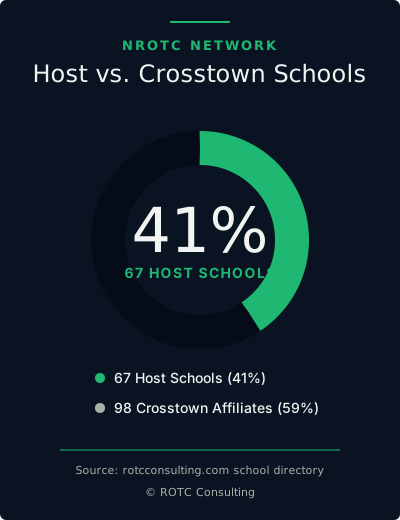
Navy ROTC operates at 165 colleges across 40 states, but only 67 of those schools actually host a unit on campus. The other 98 are crosstown affiliates, schools with a formal agreement that routes students to a nearby host for their Naval Science training. That distinction matters more than most families realize, and it is the first thing to understand before choosing where to apply.
This guide covers how the NROTC school system works, what the difference between a host school and a crosstown affiliate means for your student’s daily life, and how to choose the right school for a Navy or Marine Corps ROTC scholarship. For the full searchable list of every NROTC school by state, branch, and host or crosstown status, use our ROTC school directory.
Before you go further, here is the short version:
- Navy ROTC spans 67 host schools and 98 crosstown affiliates across 40 states. Eleven states have no NROTC presence at all.
- Host vs. crosstown affects how your student trains, not whether they can earn a scholarship or commission.
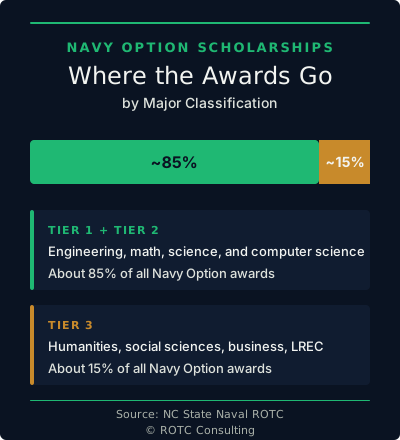
- About 85% of Navy Option scholarship awards go to students in Tier 1 or Tier 2 (STEM) majors. School choice and major choice are linked.
- The Marine option within NROTC does not use the major classification system, so Marine-track students have more flexibility in choosing a school and major.
- The College Program is a walk-on path that lets students join NROTC without an initial scholarship.
- The school directory has the full, filterable list.
How Many NROTC Schools Are There?
The number you will see on official Navy recruiting sites is “more than 170 colleges and universities.” The precise count shifts as schools are added or removed from the network, but the breakdown between host and crosstown is the more useful number for families making a decision.
Each of the 67 host schools operates an NROTC unit, sometimes called a battalion, led by a Professor of Naval Science. That unit typically serves not just the host campus but also a cluster of nearby crosstown affiliates. The result is 67 NROTC consortiums covering 165 schools total.
Geographically, the heaviest concentrations are on the coasts and in states with large military populations.
| State | NROTC Schools |
|---|---|
| New York | 13 |
| California | 11 |
| Florida | 11 |
| Massachusetts | 10 |
| Virginia | 10 |
| Louisiana | 9 |
| Texas | 9 |
| Georgia | 8 |
| Pennsylvania | 8 |
| Illinois | 7 |
For the full breakdown by state, use the school directory and filter by Navy ROTC.
What Is a Host School vs. a Crosstown Affiliate?
This is the single most important distinction every family should understand before choosing an NROTC school, and it is the one that almost every online school list leaves out.
A host school is the campus where the NROTC unit physically lives. The Department of Naval Science, the Naval Science classrooms, the Professor of Naval Science, and the battalion armory are all on that campus. If your student attends a host school, they walk to PT in the morning, walk to their Naval Science class, and train alongside the rest of the battalion as part of their normal campus routine.
A crosstown affiliate is a school that has a formal agreement with a nearby host unit but does not have its own Department of Naval Science on campus. Your student earns their degree at the crosstown school but travels to the host campus for Naval Science courses, drill, and Leadership Lab. Everything else, their major, their tuition, their campus life, stays at their home school.
The crosstown experience is not lesser. Crosstown students earn the same scholarship, meet the same commissioning requirements, and receive the same officer training as host-campus midshipmen. MIT, Harvard, Stanford, Princeton, and Georgetown are all crosstown affiliates, and their midshipmen commission alongside host-campus students with no distinction in qualification or career path.
The practical difference is daily integration. A host-campus midshipman sees the unit every day. A crosstown midshipman may see the battalion primarily on training days, typically one to two days per week plus occasional weekend events. For some students, that separation is fine. For others, the daily immersion of a host school is a better fit. It is worth visiting both types and talking to current midshipmen before deciding.
For more on what the scholarship covers and how to win one, see our guide to the Navy and Marine Corps ROTC scholarship.
How NROTC Consortiums Work
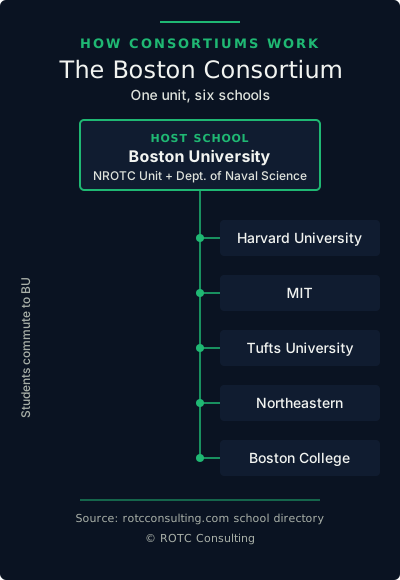
Each of the 67 NROTC units operates as a consortium. One host school anchors the unit, and a cluster of crosstown affiliates share it. The largest consortiums serve five or six schools each.
Here is what that looks like in practice.
NROTC Unit Boston, hosted at Boston University, is one of the largest in the country. It serves midshipmen from six schools: Boston University (the host), Harvard, MIT, Tufts, Northeastern, and Boston College. The battalion splits into two training companies for day-to-day operations, one based around MIT (serving MIT, Harvard, and Tufts students) and one based at BU (serving BU, BC, and Northeastern students). But they train as a single battalion and commission together.
NROTC Unit Houston, hosted at Prairie View A&M University, serves Rice University, University of Houston, Texas Southern University, and Houston Baptist University alongside its host campus. That a historically Black university hosts the consortium that includes Rice, one of the most selective private universities in the country, illustrates the institutional diversity within a single NROTC unit.
The National Capital Consortium, hosted at The George Washington University, brings together Georgetown, Howard, and Catholic University of America. All three crosstown schools are within a few miles of the host campus in Washington, D.C.
| Consortium | Host School | Crosstown Affiliates | Total Schools |
|---|---|---|---|
| Boston | Boston University | Harvard, MIT, Tufts, Northeastern, Boston College | 6 |
| Atlanta | Georgia Institute of Technology | Clark Atlanta, Georgia State, Kennesaw State, Morehouse, Spelman | 6 |
| Hampton Roads | Old Dominion University | Hampton, Norfolk State, Regent, Tidewater CC, Virginia Wesleyan | 6 |
| San Diego | University of San Diego | UC San Diego, San Diego State, Cal State San Marcos, Point Loma Nazarene | 5 |
| New Orleans | Tulane University | Dillard, Loyola New Orleans, University of New Orleans, Xavier of Louisiana | 5 |
| Houston | Prairie View A&M University | Rice, University of Houston, Texas Southern, Houston Baptist | 5 |
For a family evaluating a crosstown school, the question is not whether the school “has” NROTC. It is which consortium the school belongs to, how far the host campus is, and how the unit integrates its crosstown midshipmen.
Notable NROTC Schools by Category
The NROTC network is more diverse than most families expect. It spans Ivy League universities, senior military colleges, historically Black colleges and universities, and federal and state maritime academies. Here is a category-by-category look.
Senior Military Colleges
Five of the six federally recognized Senior Military Colleges have NROTC, and all five are host schools: The Citadel, Virginia Military Institute, Norwich University, Texas A&M University, and Virginia Polytechnic Institute (Virginia Tech). These campuses have a corps of cadets or midshipmen woven into daily life, so NROTC is not an extracurricular activity. It is the culture.
Historically Black Colleges and Universities
Multiple HBCUs participate in NROTC. Florida A&M University, Prairie View A&M University, Savannah State University, and Southern University and A&M College are host schools. Many more are crosstown affiliates: Howard University, Hampton University, Morehouse College, Spelman College, Clark Atlanta University, Norfolk State University, Tuskegee University, Dillard University, and others. Several of these schools have produced generations of Black naval and Marine Corps officers.
Maritime Academies
Maritime academies are a natural pipeline to Navy careers, and several participate in NROTC: Maine Maritime Academy, Massachusetts Maritime Academy, Great Lakes Maritime Academy, SUNY Maritime College, California State University Maritime Academy, and the U.S. Merchant Marine Academy. Most are host schools.
What Makes a Strong NROTC School?
There is no single “best” NROTC school, and any list that ranks them ignores the thing that actually decides fit: your student’s major, their branch option, and how much daily immersion in the battalion they want. A school that is ideal for a Navy Option engineer can be the wrong call for a Marine Option history major. Four things separate a strong-fit unit from a weak one.
Major depth for the Navy Option. Because roughly 85% of Navy Option scholarships go to Tier 1 and Tier 2 STEM majors, a strong school for that path is one with a deep engineering or hard-science college. The senior military colleges (Texas A&M, Virginia Tech, The Citadel, VMI, Norwich) and large technical universities fit here. A Marine Option or Tier 3 student should weight this factor far less.
Consortium size and structure. Large consortiums like NROTC Unit Boston (six schools) or Atlanta (Georgia Tech plus five affiliates) give a broad peer group and more leadership billets. Smaller units give closer mentorship from the Professor of Naval Science. Neither is better in the abstract. It depends on whether your student wants a large battalion or a tight one.
Host vs. crosstown fit. A strong school is one whose host-or-crosstown status matches how much daily contact with the unit your student wants. Immersion students should target host campuses. Students set on a specific crosstown school (Harvard, MIT, Georgetown) should confirm the commute to the host unit first.
Option availability. Confirm the school supports the specific path, Navy, Marine, or Nurse, before ranking it at all. The Nurse Option in particular is limited to schools with an affiliated nursing program.
The most useful move is not to chase a ranking but to filter the full list by these four factors. The school directory lets you filter every NROTC school by branch, state, and host or crosstown status so you can build a short list that fits your student, not a stranger’s.
How Does School Choice Affect Your NROTC Scholarship?
For the Navy Option, school choice and major choice are tightly linked, and both affect your student’s competitiveness for a scholarship.
The classification system works like this:
| Classification | What It Covers | Approximate Share of Awards |
|---|---|---|
| Tier 1 | Engineering programs of direct Navy interest: aerospace, electrical, mechanical, nuclear, computer engineering | Largest share |
| Tier 2 | Other engineering, math, and hard science: computer science, physics, chemistry, civil engineering, biomedical engineering, mathematics | Combined with Tier 1, about 85% of all awards |
| Tier 3 | All other majors: humanities, social sciences, business, plus a Language/Regional Expertise/Culture (LREC) subset | About 15% of awards |
The classification list varies slightly by host school because not every campus offers every major. A major that falls in Tier 1 at one school may not exist at another. Before your student commits to a school, check where their intended major falls on that unit’s specific list. NC State and Duke, for example, both publish their classifications on their NROTC websites.
This means that choosing a school with strong STEM programs is not just an academic preference for a Navy Option applicant. It is a scholarship strategy. A student pursuing mechanical engineering at a school with a strong engineering college is competing in the largest and most favorable scholarship pool.
For families weighing cost, remember that NROTC pays full tuition at private schools as well as public ones. An NROTC scholarship at a private university can be worth well over $150,000 across four years. For more on the public-vs-private decision, see our article on private colleges over public colleges for ROTC.
Navy Option vs. Marine Option: Does the School Matter?
For the Navy Option, school choice matters primarily because of the major classification system. A student pursuing a STEM major at a school with strong engineering or science programs is in the most competitive position.
For the Marine Option, the calculus is different. The Marine board does not use the classification system at all. Your student’s major does not affect their scholarship odds the way it does for the Navy Option. Instead, the Marine board weights physical fitness (measured by the Marine Corps PFT, which is more demanding than the Navy’s AFA), the relationship with the local Marine Officer Selection Officer, and the overall officer interview.
| Factor | Navy Option | Marine Option |
|---|---|---|
| Major matters? | Yes. Tier 1/2 STEM majors get about 85% of awards | No. Major has no classification penalty |
| Fitness test | Applicant Fitness Assessment (push-ups, plank, 1-mile run) | Marine Corps PFT (pull-ups or push-ups, plank, 3-mile run) |
| Selection board | NSTC (Naval Service Training Command) | MCRC (Marine Corps Recruiting Command) |
| Additional requirement | None beyond the standard pipeline | Six-week OCS the summer before senior year |
For a Marine-track student, the more important school-choice factors are battalion culture, proximity to the host unit, and the quality of the Marine Officer Instructor relationship, not the major classification. Students sometimes start on one track and switch later; our guide on moving between the Navy and Marine Corps options covers how that works once enrolled. For more on how the Navy ROTC board works, see our guide to the Navy ROTC board selection process.
The Navy Nurse Option: Which Schools Qualify?
Not every NROTC school supports the Nurse Option. The Navy Nurse scholarship requires enrollment at a school with an accredited nursing program that is formally affiliated with the NROTC unit.
Some schools offer the Nurse Option alongside the regular Navy and Marine options. Arizona State University, Marquette University, the University of South Carolina, Boston College, and Northeastern University are examples. Your student earns a Bachelor of Science in Nursing while completing Naval Science coursework, and commissions as a Navy Nurse Corps officer.
A few schools are nursing-only NROTC affiliates. Belmont University (crosstown to Vanderbilt’s unit), Molloy College, Russell Sage College, and Seattle University commission only into the Nurse Corps at those locations.
For families exploring the Nurse Option, see our article on Navy ROTC nurse recommendation letters for guidance on building a strong application. The NROTC Preparatory Program is another path worth understanding if your student needs additional preparation before entering the full scholarship track.
Which States Have No Navy ROTC?
Eleven states have no NROTC-affiliated school at all: Alaska, Arkansas, Delaware, Kentucky, Montana, New Hampshire, Nevada, North Dakota, South Dakota, West Virginia, and Wyoming.
If your student lives in one of these states, they will need to attend an out-of-state NROTC school. This is not a barrier to the scholarship. The NROTC board evaluates applicants nationally, not by state, and there is no state quota or apportionment the way there is for some service academy appointments. But it does mean planning for an out-of-state move, and in many cases paying out-of-state tuition if your student does not win a scholarship (the NROTC scholarship covers full tuition regardless of residency status).
The school directory can filter by state. If your student is in a state without NROTC, start by looking at neighboring states with host units. The College Program, which does not require an initial scholarship, is another way to start at an NROTC school and compete for a scholarship after arriving on campus.
How to Choose the Right NROTC School
With 165 schools to choose from, narrowing the list can feel overwhelming. Here is a practical framework.
One detail that catches families off guard: the national scholarship application requires five school choices, and each choice must be tied to a different NROTC unit. You cannot list five crosstown schools that all route through the same host as five separate choices. If your student wants to include in-state tuition as a fallback, place a public in-state school among the top three choices. Two logistics to plan early: the Navy ROTC board dates and deadlines that set when applications are reviewed, and the DoDMERB physical, the medical qualification step every scholarship applicant must clear regardless of school.
Once a school list is set and the application is moving, the scholarship interview is the next hurdle. Our guide to preparing for your Navy ROTC scholarship interview covers what the board looks for.
Frequently Asked Questions
Can you do Navy ROTC at a community college?
A few community colleges appear as NROTC affiliates, but NROTC scholarship recipients must be enrolled in a four-year degree program. Community college affiliations typically support specific training arrangements rather than full scholarship paths.
Can you transfer between NROTC schools?
Transfers are possible but require coordination with both the departing and receiving NROTC units, plus approval from the unit's commanding officer. The scholarship follows the student, but the process takes planning. Start the conversation early if a transfer is on the table.
Do you have to live on campus at an NROTC school?
NROTC does not require on-campus housing, though some host schools have optional midshipmen housing. The scholarship covers tuition and fees but does not cover room and board, so housing is a separate family decision.
Can you attend an NROTC school without a scholarship?
Yes, through the College Program. Students join the battalion, take Naval Science courses, and train alongside scholarship midshipmen with no service obligation. Strong performers can earn a scholarship or Advanced Standing by the start of junior year.
Is the Marine option available at every NROTC school?
Yes. The Marine option is a track within NROTC, not a separate program. It is available at every NROTC-affiliated school, whether host or crosstown.
How do you apply to an NROTC school?
The NROTC scholarship application and college admission are two separate processes. You apply for the scholarship through the national NROTC scholarship application and apply to the colleges separately through their regular admissions process. Winning the scholarship does not guarantee college admission, and being admitted to the college does not guarantee the scholarship.
Can you do Navy ROTC and play college sports?
Yes, and many midshipmen are student-athletes. The scheduling demands of NROTC training, PT, and Naval Science courses alongside a sport are significant, but units generally work with student-athletes on scheduling. Discuss this with the unit before committing.
What is the NROTC Preparatory Program?
The Preparatory Program (sometimes called NPP) is for students who meet eligibility requirements but need additional academic preparation, typically in math and standardized testing, before entering the full scholarship program. See our guide to the NROTC Preparatory Program for details.
How many NROTC scholarships are awarded each year?
Thousands of students compete for a limited number of awards each year. The board selects from a deep national pool, and only a fraction win a four-year scholarship straight out of high school. The exact number varies by year and by option (Navy, Marine, Nurse).
Do all NROTC schools offer the same training?
The Naval Science curriculum is standardized across all NROTC units. The academic program, campus culture, and extracurricular opportunities are what differentiate one school from another. Choose the school based on academic fit and campus environment, not the NROTC curriculum itself.
What are the best Navy ROTC schools?
There is no official ranking, and the right school depends on your student's branch option and major. For the Navy Option, schools with deep STEM programs are strongest because about 85% of scholarships go to Tier 1 and Tier 2 majors. The senior military colleges (Texas A&M, Virginia Tech, The Citadel, VMI, Norwich) and large technical universities fit that profile. For the Marine Option, battalion culture and proximity to the host unit matter more than the major.
How do I find Navy ROTC schools near me?
Use the school directory and filter by state to see every host and crosstown school in your area. Eleven states have no NROTC-affiliated school at all, so students in those states look to neighboring states with host units. Distance to the host campus matters most for crosstown schools, where students commute to the host for Naval Science training.
Are there Navy ROTC schools in every state?
No. Navy ROTC operates in 40 states. Eleven states have no NROTC-affiliated school: Alaska, Arkansas, Delaware, Kentucky, Montana, New Hampshire, Nevada, North Dakota, South Dakota, West Virginia, and Wyoming. Students there attend out of state, and the NROTC board evaluates applicants nationally with no state quota.
The school data in this article is drawn from the rotcconsulting.com school directory, which tracks host and crosstown status for every NROTC-affiliated institution. Official NROTC school listings are maintained by the Naval Service Training Command at netc.navy.mil. The appearance of U.S. Department of Defense visual information does not imply or constitute DoD endorsement.