Four years of college tuition, fees, a monthly stipend, and a book allowance. Published Department of Defense figures put an ROTC scholarship’s value at $40,000 to $80,000 at a public university, and over $200,000 at a private one. The prize is large enough that it deserves a clear-eyed look, not a guess.
Here is the problem most families run into. Ask three forums how the scholarship works and you get three answers, and some of them are years out of date or were never accurate to begin with.
The rules changed for this cycle. Test-score policy changed. The fitness test changed. Even the way majors are ranked changed.
This guide walks through what the scholarship pays for, who qualifies, what actually moves an applicant up or down at the board, and the exact 2026-2027 deadlines your student has to hit. Everything here is current for the 2026-2027 High School Scholarship Program cycle, effective July 1, 2026.
What the Air Force ROTC Scholarship Pays For
An Air Force ROTC scholarship comes in three types, and the type controls how much tuition is covered. Your student does not pick the type. The board assigns it.
| Scholarship type | Tuition coverage | Practical fit |
|---|---|---|
| Type 1 | Full tuition and most fees, no dollar cap | Any school, including higher-cost private universities |
| Type 2 | Up to $18,000 per year ($9,000 per semester or $6,000 per quarter) | Covers full tuition at many public in-state schools |
| Type 4 | Up to $36,000 per year ($18,000 per semester or $12,000 per quarter) | Broader coverage than Type 2, still capped |
If tuition and fees at your student’s school run higher than the cap on a Type 2 or Type 4 award, the family covers the difference. That is the single most common surprise, so run the numbers against the actual sticker price of each school on your student’s list.
Beyond tuition, every scholarship recipient receives a book allowance of $900 per year and a monthly living stipend that increases with each year in the program. Those two benefits are the same regardless of scholarship type.
There is also a Housing Scholarship Conversion, which was formerly called the Room conversion. The benefit is unchanged at up to $10,000 per year, but a scholarship recipient can elect to convert part of the tuition benefit toward on-campus housing costs instead.
Two details matter here. The conversion must be requested before the Fall term begins, and it has to be re-requested every single academic year. It does not roll over automatically.
What the scholarship does not cover is room and board in the ordinary case, unless the Housing conversion is elected, and anything above a Type 2 or Type 4 cap. Meal plans, dorm costs, and personal expenses are generally the family’s responsibility. Knowing that up front keeps the college budget honest.
Air Force ROTC Scholarship Requirements for 2026-2027
The Air Force ROTC scholarship requirements start with hard floors your student either clears or does not. Meet all of them before spending energy on anything else.
| Requirement | Minimum for 2026-2027 |
|---|---|
| GPA | 3.3, unweighted cumulative |
| SAT | 1310 |
| ACT | 28 |
| CLT | 93 (accepted for the first time this cycle) |
| Age | 17 at activation, no older than 30 by December 31 of the commissioning year |
| Citizenship | U.S. citizen |
Use program code 0548 so scores route to AFROTC correctly. Scores are not super-scored across different test sittings, which is a rule worth reading twice, because it changes how your student should schedule testing.
There is an enrollment restriction that trips up more families than you would expect. An applicant must not have attended a post-secondary institution full time as a student. New this cycle, the guidance clarifies that a service-academy prep school, such as a Naval Academy, Military Academy, or Air Force Academy prep school, counts as disqualifying post-secondary attendance. If your student has been through one of those, confirm eligibility before investing in the application.
The required documents are straightforward but depend on other people, so start them early:
- The online application in the WINGS system
- Official high school transcripts
- The Counselor Form, completed by the school counselor, or by a parent or guardian for home-school families
- The PFA Certification Form, documenting the fitness assessment
One point that saves wasted effort. Letters of recommendation are not accepted. The Counselor Form is the only recommendation-style document in the file, so there is no reason to chase down teacher or coach letters.
What Actually Changes Your Odds at the AFROTC Board
This is where families most want a formula, and it is exactly where a bad formula does the most damage. AFROTC publishes hard minimums (CGPA, SAT/ACT/CLT) and a qualitative process (structured interview, PFA, academic review). The specific weighting across components is held internally by HQ AFROTC and is not publicly released. Prepare strong performance across all components rather than optimizing for one.
With that framing set, here is what the board actually evaluates and what your student can control.
| Factor | What AFROTC confirms | What to improve |
|---|---|---|
| Academics | GPA and test scores are reviewed against floors and beyond | Raise the strongest test in one clean sitting; keep senior-year grades up |
| Interview | Required for every applicant, conducted by a detachment official | Prepare early, practice out loud, know why Air Force and why officer |
| Fitness | Current PFA measured and certified on the current scoresheet | Train specifically for the current 2.0-mile run standard |
| Intended major | Ranked on a criticality scale that reflects Air Force demand | Choose a genuine interest with the criticality system in mind |
The interview is required for every applicant, and it is conducted by an O-4 (major) or higher detachment official. If the applicant lives overseas, a USAFA Academy Liaison Officer may conduct it. The interview is assigned to the detachment closest to the applicant’s home of record, and reassignment is denied when it is requested for:
- Personal preference, with no other cause
- Converting an in-person interview to virtual
- A move beyond an 8-hour driving radius
- Lining up with a college-visit trip
Plan around the detachment your student is actually assigned to, not the one that would be convenient.
The Physical Fitness Assessment changed this cycle. It now consists of one minute of push-ups, one minute of sit-ups, and a timed run, and alternate events, including the HAMR shuttle run, are explicitly not accepted. The assessment must be recorded on the current-cycle scoresheet.
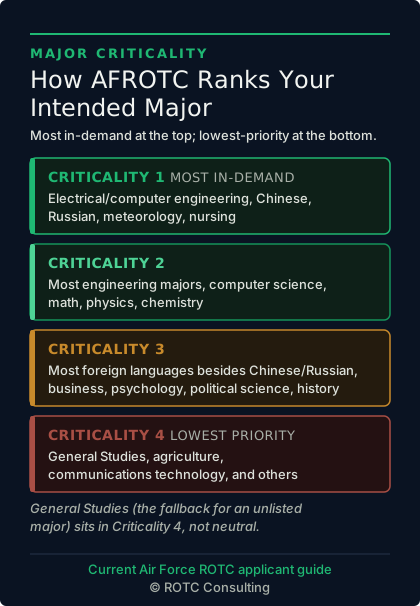
Intended major carries real weight through a criticality system, and this cycle it is spelled out on an explicit 1-to-4 scale, where 1 is the most in-demand for the Department of the Air Force. Criticality 3 and 4 majors are enumerated for the first time this cycle. Examples of Criticality 1 majors include electrical and computer engineering, Chinese Mandarin, Russian, meteorology and atmospheric science, and nursing. These reflect skills the Air Force and Space Force are actively short on.
How to Build the Strongest File Before Board 1
Five things separate a strong file from a rushed one, and none of them require luck.
Building this file well takes an outside read before the deadlines tighten, someone who can look at the whole picture and tell you plainly where your student stands against both boards.
2026-2027 AFROTC Board Dates and Timeline
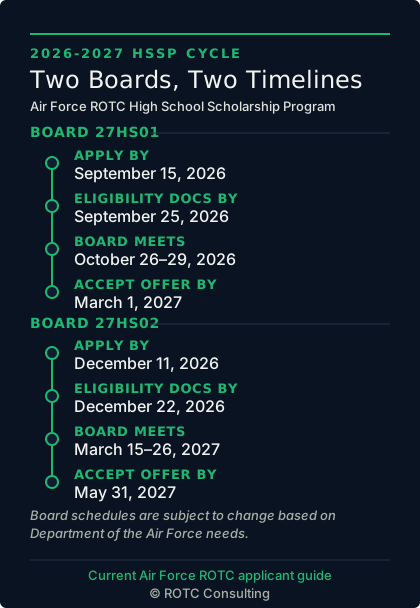
There are two boards this cycle. An applicant is considered by the first board whose deadlines they meet with a complete file, so the calendar drives everything.
| Milestone | Board 27HS01 | Board 27HS02 |
|---|---|---|
| Application deadline | September 15, 2026 | December 11, 2026 |
| Eligibility documents due | September 25, 2026 | December 22, 2026 |
| Board meets | October 26-29, 2026 | March 15-26, 2027 |
| Offer acceptance deadline | March 1, 2027 | May 31, 2027 |
Board schedules are subject to change based on Department of the Air Force needs, so verify the current dates as your student’s timeline gets close.
Related: For the full deadline tracker across both boards, see Air Force ROTC Scholarship Deadlines.
After You Win: Offer Acceptance and What Can Still Derail It
When the board makes an offer, it arrives as a Letter of Offer that has to be accepted by the deadline tied to that board, March 1, 2027 for the first board and May 31, 2027 for the second. Miss the acceptance window and the offer can lapse, so treat that date as firm.
Here is a fact that surprises almost every family, and it saves a lot of wasted worry. DoDMERB medical clearance does not begin at application. It begins only after a scholarship offer is made. There is no reason to gather or send medical records before an offer arrives, because the medical review is triggered by the offer, not by the application.
Winning the scholarship is not the same as keeping it. After activation, a cadet keeps the benefit by contracting with the detachment, staying continuously enrolled at an AFROTC-affiliated school, meeting academic and fitness standards, and remaining on track toward commissioning. The scholarship is a running commitment on both sides, not a one-time award.
If You Do Not Win the Scholarship
Not winning the national scholarship is not the end of the road, and it is worth saying plainly. An applicant who is not selected, or who is found ineligible for the high school scholarship, can still join Air Force ROTC as a non-scholarship cadet at their enrolling school’s detachment.
From there, the door is not closed. Cadets in the program can compete for in-college scholarship opportunities in later years, based on their performance once they are actually in uniform and in class. Plenty of officers commissioned without ever holding a high school scholarship.
Common Mistakes That Quietly Hurt AFROTC Applicants
Most of the damage in an application is self-inflicted and avoidable. These are the ones we see repeatedly:
- Relying on old scoring percentages that were never official. Point-weight numbers floating around forums, and even on older versions of this very page, trace back to no authoritative Air Force source. Do not build a plan around them.
- Assuming test scores can be super-scored across sittings. They cannot. One strong, complete sitting is what counts, so plan testing accordingly.
- Training for the outdated 1.5-mile fitness standard. The current assessment uses a 2.0-mile run. Conditioning for the shorter distance leaves your student underprepared on test day.
- Picking General Studies without understanding it. It is the lowest-priority major category, Criticality 4, not a neutral choice. Select a real, listed major that fits.
- Assuming an interview location can be changed for convenience. Detachment assignment is based on home of record and is not moved for preference, virtual conversion, or a college visit.
Frequently Asked Questions
What GPA do you need for an Air Force ROTC scholarship?
The minimum for the 2026-2027 cycle is a 3.3 unweighted cumulative GPA. That is an eligibility floor, not a competitive target. Selected applicants generally carry GPAs above the minimum, so treat 3.3 as the point where an application becomes eligible rather than the point where it becomes strong.
What SAT, ACT, or CLT score do you need?
The minimums are a 1310 SAT, a 28 ACT, or a 93 CLT for the 2026-2027 cycle. Use program code 0548 so scores route to AFROTC. As with GPA, these are floors. Competitive applicants typically score above the minimum on their strongest single test.
Does Air Force ROTC superscore the SAT or ACT?
No. Scores are not super-scored across different test sittings. The board looks at results from a single sitting rather than combining your best section scores from separate dates. Because of that, plan for one strong, well-prepared test rather than stacking section highs across multiple attempts.
What does an Air Force ROTC scholarship cover?
It covers college tuition and most fees for up to four years, plus a $900 annual book allowance and a monthly living stipend that increases each year. Depending on the assigned scholarship type, tuition coverage may be full or capped, and any amount above a cap is the family's responsibility.
Does Air Force ROTC pay for housing?
Not directly in the standard case. A recipient can elect the Housing Scholarship Conversion, worth up to $10,000 per year, to apply part of the benefit toward on-campus housing. It must be requested before the Fall term begins and re-requested every academic year, and it does not renew automatically.
When is the Air Force ROTC scholarship deadline for 2026-2027?
The first board, 27HS01, closes applications on September 15, 2026, with eligibility documents due September 25, 2026. The second board, 27HS02, closes applications December 11, 2026, with documents due December 22, 2026. Board dates can change based on Department of the Air Force needs, so verify as you go.
Do you need letters of recommendation for AFROTC?
No. Letters of recommendation are not accepted for the Air Force ROTC scholarship. The only recommendation-style document is the Counselor Form, completed by a school counselor, or by a parent or guardian for home-school families. There is no need to gather teacher or coach letters.
Can you join Air Force ROTC without a scholarship?
Yes. Students who are not selected can enroll as non-scholarship cadets at their college's detachment, complete the same training and coursework, and compete for in-college scholarship opportunities in later years. Many officers commission without ever holding a high school scholarship.
If your student is heading toward the interview, the Air Force ROTC Scholarship Interview Questions guide is the natural next read, and our breakdown of SAT and ACT Scores for ROTC Scholarships helps set a realistic testing target. Related: for how the board thinks across services, see Selection Criteria for ROTC Scholarships and the cross-branch ROTC Scholarships overview. When it is time to build the school list, How to Choose an AFROTC School walks through the tradeoffs that matter under a capped award.
The appearance of U.S. Department of Defense (DoD) visual information does not imply or constitute DoD endorsement.