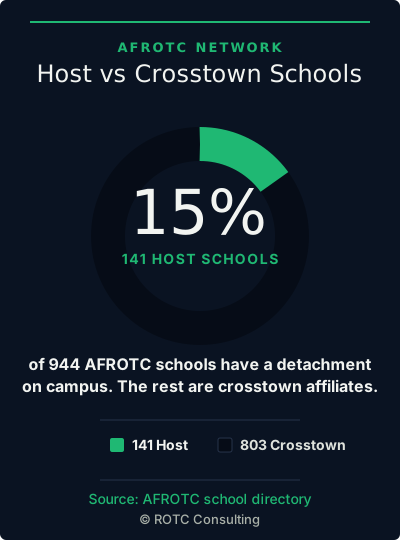
Your student just told you they want to pursue Air Force ROTC, and now you are trying to figure out which colleges even offer it. The answer is broader than you might expect. 944 colleges and universities participate in AFROTC, but only 141 of them actually host a detachment on campus. The other 803 send students to a neighboring host through crosstown agreements.
That distinction matters more than most families realize. Schools with Air Force ROTC programs differ in ways that directly affect your family’s out-of-pocket cost, your student’s daily schedule, and the quality of the four-year ROTC experience. The real question is not which schools have AFROTC. It is which type of school sets your student up for the strongest scholarship outcome.
This guide covers the ten things parents need to understand before narrowing the list. For the full searchable list of all 944 schools, see the AFROTC school directory or browse by state in the school directory.
Key Takeaways
- 944 schools participate in AFROTC (141 host detachments, 803 crosstown affiliates). Your student can attend almost any major university.
- The AFROTC scholarship covers tuition and fees only, not room and board. School choice determines how large the remaining gap is.
- Some schools add their own incentives, including free room and board or in-state tuition waivers, that can close most of the remaining cost.
- Scholarship type (1, 2, or 4) is assigned by AFROTC based on your student’s major, not chosen by the family.
- Host vs. crosstown affects daily logistics and commute, not scholarship eligibility.
- AY26-27 raised academic minimums to a 3.3 GPA, 1310 SAT, and 28 ACT.
If your student’s school appears in the AFROTC college locator or the school directory, it participates. The harder question is whether it is a host or a crosstown, and what that means financially.
1. Host Schools vs. Crosstown Schools: The Distinction That Changes Everything
If you assumed every school “with AFROTC” has a full detachment on campus, you are not alone. Most families make that assumption. Many are surprised to learn their student would commute to another campus two or three times a week.
What host means
The AFROTC detachment is physically on campus. Aerospace Studies classes, Leadership Lab, physical training, and informal interaction with cadre all happen where your student already goes to class. There are 141 host detachments nationwide, at schools ranging from large state flagships like Ohio State to specialized institutions like Embry-Riddle Aeronautical University.
What crosstown means
The other 803 participating schools are crosstown affiliates. Your student earns their degree at their home school and commutes to a nearby host campus for AFROTC classes and Leadership Lab. Georgia Tech’s Det 165, for example, serves 11 crosstown partners across metro Atlanta, including Agnes Scott College. CU Boulder’s Det 105 serves nine partner schools, some more than 30 miles away.
A side-by-side comparison shows the practical differences.
| Factor | Host School | Crosstown School |
|---|---|---|
| Detachment on campus | Yes | No |
| Commute to AFROTC | None | 2-3 times per week |
| AS course credits | Regular enrollment | Transfer credits |
| Leadership Lab access | Daily informal access | Scheduled visits only |
| Number of schools | 141 | 803 |
Crosstown scholarship entitlements may be capped at the host institution’s rate. If your student’s crosstown school costs more than the host, the scholarship may not cover the full tuition difference.
What this means practically
Aerospace Studies course credits at a crosstown school are usually treated as transfer credits at the home institution. They typically do not affect the home GPA in either direction. Some detachments consolidate crosstown training into a single heavy day per week. University of Michigan’s Det 390, for instance, schedules all weekly crosstown requirements on Thursdays to reduce commute trips.
Scholarship eligibility is identical for host and crosstown cadets. The difference is in the daily experience. If two schools are otherwise equal and one is a host, the host gives your student a more integrated AFROTC experience with less time on the road.
For a deeper comparison of how college ROTC programs stack up across branches, see our full guide.
2. What the Scholarship Actually Covers (and What It Does Not)
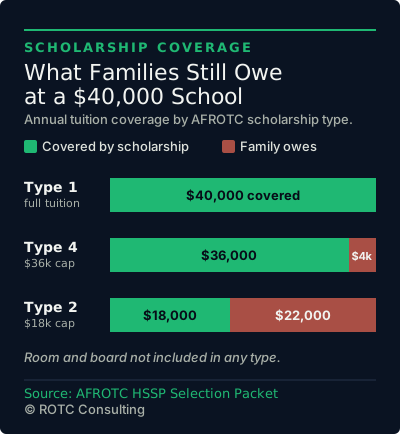
AFROTC scholarships cover tuition and fees only. Not room. Not board. Not the tuition above a Type 2 or Type 4 cap. This is the single biggest misconception families carry into the process, and it changes how you should think about school selection entirely.
Current scholarship types (AY26-27)
AFROTC assigns the scholarship type at the time of the award based on your student’s major and the Department of the Air Force’s current needs. The student does not choose.
| Type | Annual Cap | Covers | Best For |
|---|---|---|---|
| Type 1 | Uncapped | Full tuition and fees | Any school, any cost |
| Type 2 | $18,000 | Tuition and fees to cap | Lower-cost public universities |
| Type 4 | $36,000 | Tuition and fees to cap | Mid-cost schools |
| Room Conversion | $10,000 | On-campus housing only | Low-tuition schools with high housing costs |
All scholarship types also include a $300 to $500 monthly stipend (increasing by class year) and $900 per year in book allowance, per the current AFROTC applicant guide.
What was retired
Type 7 and the Charles McGee Leadership Award are no longer high school scholarship options as of AY26-27, per the AFROTC HSSP Selection Packet. Several competitor websites still list Type 7 as current.
If you see Type 7 listed on another website, that information is outdated. Type 7 and the Charles McGee Leadership Award were retired as HSSP options beginning AY26-27.
Who gets which type
Critical majors (Electrical Engineering, Computer Science, Nursing, Meteorology, Chinese, Russian) are most likely to receive a Type 1. Non-technical majors typically receive a Type 2 ($18,000 cap). Type 4 ($36,000) bridges the gap for moderately critical fields. AFROTC does not publish the exact formula, and assignment can shift year to year as Department of the Air Force priorities change.
The math that matters
Consider the same student with a Type 2 ($18,000 cap) at two different schools. At a private university charging $45,000 in tuition, the family owes $27,000 per year in uncovered tuition, plus full room and board. At a $12,000 in-state public university, the Type 2 covers all tuition, and only room and board remains.
The school your student attends does not affect whether they win the scholarship. It dramatically affects what the family pays after they win it.
For a complete breakdown of what each scholarship type covers, see ROTC scholarship benefits explained. For the full list of AY26-27 changes, including the Type 7 retirement, see our detailed update.
3. Schools That Add Free Room and Board for AFROTC Scholarship Winners
The federal scholarship covers tuition. At certain schools, the institution covers much of the rest. These incentives are publicly posted on individual detachment websites, but no single guide compiles them. We confirmed seven.
| School | Incentive | Covers | Key Condition |
|---|---|---|---|
| Texas A&M (Det 805) | Patriot Scholarship | Room and board after other aid applied | Part of $50M university commitment |
| The Citadel (SMC) | Service to Country Scholarship | Up to 4 years room and board | FAFSA-based; must maintain ROTC scholarship |
| Colorado State (Det 090) | Provost Room & Board Stipend | $8,000/yr toward housing | HSSP recipients only |
| West Virginia (Det 915) | Room + Go 13 Meal Plan | Room and meals for freshmen | First-come, first-served (Mar 1 to Jul 1) |
| Embry-Riddle Prescott (Det 028) | Institutional Guarantee | $8,500/yr minimum | Plus $30K frontloading option for 3-year recipients |
| U of Kentucky (Det 290) | Housing Support Pool | $50,000 annual pool toward housing | Freshman and sophomore years |
| Mississippi State | Out-of-State Tuition Waiver | OOS tuition differential | All active AFROTC cadets, not just scholarship holders |
These incentives are not listed on afrotc.com. You will only find them on individual detachment websites or by calling the cadre directly. Ask every school on your student’s list.
These seven are what we confirmed with published sources. More schools likely offer similar arrangements. Some incentives are need-based (The Citadel requires FAFSA), some are first-come-first-served (West Virginia opens applications March 1 with a July 1 deadline), and some apply to all active cadets regardless of scholarship status (Mississippi State’s out-of-state waiver). The conditions vary, so read the fine print for each.
The question to ask each detachment is direct: “Does your university offer any institutional incentives for HSSP scholarship recipients beyond the federal award?” The difference between a school with a Patriot Scholarship and one with nothing can be $15,000 or more per year in family cost. These incentives also reduce the risk if your student’s federal scholarship type carries a cap below the school’s tuition.
Related: See the full breakdown of college incentives for ROTC programs across all branches.
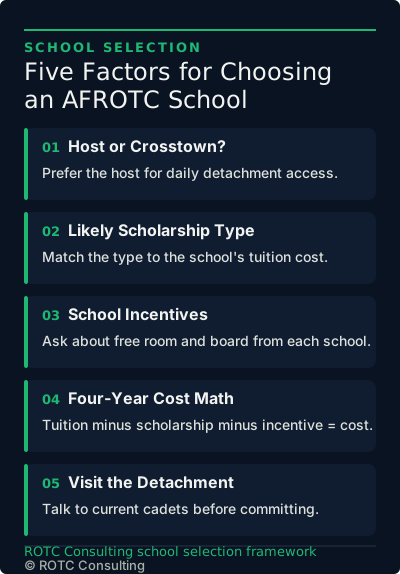
4. How to Choose the Right AFROTC School: A Five-Factor Framework
Choosing a school for AFROTC is not the same as choosing a school for academics alone. Five factors matter, roughly in this order.
Factor 1: Host or crosstown?
If two schools are otherwise equal, prefer the host. Your student gets the detachment on campus, daily cadre interaction, and no commute. If the crosstown school is dramatically better academically or financially, the commute is manageable.
Factor 2: What scholarship type will the major likely receive?
Critical majors, including Electrical Engineering, Computer Engineering, Chinese, Russian, Atmospheric Science, and Nursing, are most likely to receive a Type 1 (full tuition, uncapped). At a low-cost public school, that coverage is generous but nearly redundant. At a $55,000 private school, a Type 1 is transformative. Match the likely scholarship type to the school’s sticker price.
Factor 3: Does the school add its own incentive?
Refer to the seven schools listed above. The institutional incentive can be the difference between covering room and board or owing it entirely out of pocket. A student at Texas A&M with a Patriot Scholarship may pay close to zero. The same student at a comparable school with no institutional incentive may owe $15,000 per year in room and board alone.
Factor 4: Run the real math
Tuition plus room and board, minus the scholarship type, minus school incentive, equals family out-of-pocket per year. Multiply by four. That is the number that determines whether a school is affordable.
Factor 5: Visit the detachment
Detachment culture, size, and cadre quality vary widely. A student who thrives in a small 40-cadet unit is different from one who benefits from a 200-cadet detachment with more resources and structure. Talk to current cadets. Ask about retention rates and Field Training selection.
Before narrowing your student’s AFROTC school list, confirm these five:
- Host or crosstown status checked for every school on the list
- Likely scholarship type identified based on your student’s intended major
- School-specific incentives researched by contacting each detachment
- Four-year out-of-pocket math completed for the top three choices
- Detachment visit scheduled or current cadets contacted
For a broader look at what makes your student competitive across all three ROTC branches, see our selection criteria guide.
5. Senior Military Colleges: The Five AFROTC Schools With Federal Protection
Six universities hold a legal status that no other school can claim. Under 10 U.S.C. 2111a, their ROTC detachments cannot be reduced or terminated by the Department of Defense, even during full mobilization. Five of the six offer Air Force ROTC.
The AFROTC Senior Military Colleges are Texas A&M University (Det 805), Virginia Military Institute, The Citadel, Norwich University, and Virginia Tech (Det 875). The University of North Georgia is an SMC but does not have an AFROTC detachment.
Under 10 U.S.C. 2111a, the Department of Defense cannot terminate or reduce ROTC at a Senior Military College even during full mobilization. No other category of school has this protection.
Why SMCs matter for AFROTC families
Stability is guaranteed by statute, not by administrative preference. SMC graduates who qualify and want active duty receive guaranteed active-duty commissions. Two of the six, Texas A&M and The Citadel, have the strongest institutional incentive arrangements we found in our research. Military culture at these schools is integrated into campus life rather than attached to a civilian university experience. AFROTC cadets at SMCs participate in the corps of cadets structure all four years, which builds a depth of military culture that a detachment at a large civilian university typically cannot match.
The tradeoff
SMCs have a structured military lifestyle that extends well beyond the ROTC detachment itself. Uniform requirements, conduct codes, and regimented daily schedules apply to all students, not just cadets. That structure is a feature for some families and a clear mismatch for others. Your student should visit and spend time with current cadets before committing. The daily reality of an SMC is substantially different from AFROTC at a traditional university.
For families weighing whether a private college or public university is the better AFROTC path, SMCs occupy a distinct category worth evaluating on their own terms.
6. Why Your Student’s Major Matters More Than the School’s Ranking
AFROTC does not rank schools. It ranks degree fields. The Air Force sorts every major into criticality levels that directly determine which scholarship type a student receives, and that assignment changes the financial equation more than any school’s prestige.
Critical majors (highest priority)
Electrical and Computer Engineering, Chinese, Russian, Atmospheric Science and Meteorology, and Nursing. These fields receive the most favorable scholarship types, per the AY26-27 HSSP Selection Packet.
Why this changes school selection
An Electrical Engineering student with a Type 1 has full tuition covered at any school in the country. The school’s sticker price barely matters for tuition (the family still owes room and board). A Communications major with a Type 2 ($18,000 cap) at a school charging $40,000 in tuition owes $22,000 per year in tuition alone, before room and board.
If your student is pursuing a non-technical major, school cost matters enormously. Choose a lower-tuition school where the Type 2 cap covers all or most of tuition, and look for schools with institutional incentives to close the room and board gap.
The major-change trap
Scholarships must be activated within the awarded criticality category. If your student switches from a Critical or Technical major to a Non-Technical major after receiving the award, the scholarship may be withdrawn. This is not a hypothetical. It happens, and it is written into the selection packet.
Switching from an engineering major to a liberal arts major after receiving an AFROTC scholarship is not just an academic decision. AFROTC can withdraw the scholarship if the new major falls outside the awarded criticality category.
Have this conversation with your student before they commit to a school based on scholarship math tied to a specific major. For a comprehensive look at building a competitive AFROTC application, see our full guide.
7. AY26-27 Changes Every Parent Should Know
The AY26-27 application cycle brought meaningful changes to eligibility, scholarship types, and the application timeline. If the information your family is reading does not reflect these updates, it is outdated.
Academic minimums raised
| Factor | AY25-26 | AY26-27 |
|---|---|---|
| Minimum GPA | 3.0 | 3.3 |
| Minimum SAT | 1240 | 1310 |
| Minimum ACT | 26 | 28 |
| Type 7 | Available | Retired |
| Type 4 | N/A | $36,000/yr |
| Space Force Board | Separate | Consolidated |
These are hard floors. A student with a 3.1 GPA and a 27 ACT would have been eligible last year. They are not eligible this year. The minimums were published in the AY26-27 HSSP Applicant Guide on afrotc.com.
Scholarship types changed
Type 7 was retired. Type 4 ($36,000 per year) was added. The Charles McGee Leadership Award is no longer an HSSP option. These changes are confirmed in the AY26-27 HSSP Selection Packet.
Space Force board consolidated
AY25-26 ran a separate HSSP-SF board with its own deadlines and interviews. AY26-27 consolidated to one Department of the Air Force process. Space Force selection now happens later, during college.
Timeline compressed
The application window runs from July 1 to December 12. The first board cutoff is September 16. The second is December 12. Supporting documents and scores are due approximately December 23, with no extensions. This is earlier and tighter than AY25-26. For comparison, the AY25-26 first board cutoff was October 18 and the second was March 14. Families who wait until fall of senior year to begin are now operating on a significantly shorter runway.
For the full timeline and AFROTC scholarship board dates, see our deadline tracker. For a detailed look at every AY26-27 change, see the full update.
8. The Room Scholarship Conversion: When It Makes Sense and When It Does Not
Any AFROTC scholarship type can be converted to a Room Scholarship worth up to $10,000 per year for on-campus housing. That sounds helpful until you understand the mechanism. The conversion replaces tuition coverage. It is not additive.
When it makes sense
Your student attends a very low-cost public school where in-state tuition is under $10,000 per year, or your student has other grants and aid that fully cover tuition. In those cases, converting to room coverage addresses the bigger remaining cost.
When it does not
A Type 1 winner at a $40,000 private school would give up full tuition coverage (worth $40,000) for $10,000 in room coverage. A Type 2 winner at an $18,000 school would trade the full $18,000 tuition benefit for $10,000 in housing. The math is unfavorable in both cases.
The Room Scholarship conversion replaces your student’s tuition coverage. It does not add to it. At any school where tuition exceeds $10,000 per year, converting is almost certainly a net loss for the family.
The school-incentive alternative
Colorado State already provides an $8,000 per year Provost Room Stipend funded by the university. A student at CSU with a federal scholarship and the Provost Stipend has tuition plus most of room covered without touching the Room Conversion. This is exactly why school-specific incentives change the equation.
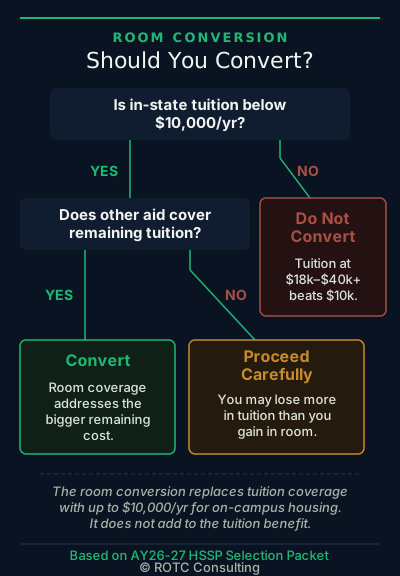
The Room Scholarship Conversion replaces tuition coverage. Convert only when the math favors it.
For the full housing breakdown, see ROTC scholarship benefits and housing explained.
9. Two Logistics Most Families Overlook: The Interview and the DoDMERB Exam
Two parts of the AFROTC process intersect with school selection in ways families rarely anticipate.
The interview happens near home, not at the chosen school
The AFROTC HSSP interview is conducted at the nearest detachment to your student’s home address. It is a structured interview administered by an officer at the rank of Major or above. The detachment commander must personally conduct 25 percent of all interviews, per DAFMAN 36-2032. The school your student plans to attend has no bearing on where the interview happens.
The interview is conducted at the nearest AFROTC detachment to your home, not at the school your student plans to attend. If the nearest detachment is two hours away, plan accordingly.
DoDMERB medical exam scheduling
Every AFROTC scholarship recipient must pass a Department of Defense Medical Examination Review Board physical. Exam locations are assigned based on your student’s home address. In some regions, wait times can extend several weeks. Starting the process early gives your family more runway if a remedial or waiver is needed.
Why this affects school selection
If your student’s top-choice crosstown school is far from a host detachment, the student will still need to travel to the host for the interview. Families in remote areas should factor in that travel. Similarly, DoDMERB exam locations in rural areas may require significant travel.
For a detailed look at how to prepare for the AFROTC scholarship interview, see our interview guide. For a full overview of the DoDMERB physical and medical process, see our DoDMERB guide.
10. The Full AFROTC Network: 944 Schools Across All 50 States
AFROTC operates 141 host detachments and maintains crosstown agreements with 803 additional schools, for a total of 944 participating institutions. These span all 50 states and include large research universities, small liberal arts colleges, historically Black colleges and universities, and the Senior Military Colleges.
The numbers in context
The 141 host schools range from large state flagships like the University of Florida to specialized institutions like Embry-Riddle and The Citadel. The 803 crosstown schools partner with a nearby host. Some hosts serve ten or more crosstown partners simultaneously. Georgia Tech’s Det 165 serves 11 Atlanta-area schools. Others serve two or three.
Holm Center messaging references over 1,100 schools. Our verified database counts 944 with active host or crosstown status. The difference reflects schools that are listed but no longer actively participating or have changed affiliation.
What you will not find in a raw list
Scale numbers do not tell you which schools offer institutional incentives, which detachments have strong Field Training selection rates, or how large and active the cadet corps is. That context is what the rest of this guide covers, and why the AFROTC school directory and the full school directory include filtering by host status, branch, and state.
Triple-branch schools
Some schools offer Army, Navy, and Air Force ROTC on a single campus. If your student has not committed to one branch, a triple-branch school lets them explore all three commissioning paths before making a final decision. Students can take introductory Aerospace Studies or Military Science courses without committing to a contract, which means the first year or two at a triple-branch school can function as a low-risk exploration period. For a general overview of ROTC scholarships across all branches, see our introductory guide.
How to use the directory
The AFROTC school directory lets you search and filter all 944 schools by name, state, and host or crosstown status. Start by entering your student’s preferred state, then filter for host schools. If none of the hosts align with your student’s academic interests, expand to crosstown affiliates and note which host detachment each one feeds into.
Frequently Asked Questions
Does the school my student chooses affect their chances of winning an AFROTC scholarship?
No. The AFROTC HSSP is a national competition evaluated centrally at HQ AFROTC. School choice does not factor into the board’s selection decision. It affects scholarship activation and what the family pays out of pocket, not selection odds. Your student must attend a school with a host or crosstown agreement to activate the award, and the award is portable to any participating school.
Can my student attend a school that does not have AFROTC on campus?
Yes, through a crosstown agreement. 803 of the 944 AFROTC-affiliated schools are crosstowns. Your student attends their chosen school and commutes to the host detachment for Aerospace Studies classes and Leadership Lab. See the host vs. crosstown section above for the full breakdown.
Does an AFROTC scholarship cover room and board?
No. The standard scholarship covers tuition and fees only. Any scholarship type can be converted to a Room Scholarship (up to $10,000 per year for on-campus housing), but that conversion replaces tuition coverage, not adds to it. Some schools offer their own institutional room and board incentives on top of the federal award. Ask each detachment what school-funded support exists. See sections 2, 3, and 8 above for the full breakdown.
Which scholarship type will my student receive?
AFROTC assigns the type based on major criticality. The student does not choose. Critical majors (Electrical Engineering, Computer Science, Nursing, Meteorology, Chinese, Russian) receive the most favorable types. Non-technical majors typically receive Type 2. See section 6 for details.
What is a Senior Military College, and is it a better choice for AFROTC?
Six universities hold SMC status under federal law, and five of the six offer AFROTC. They have federally protected detachments, guaranteed active-duty commissions for qualifying graduates, and often the strongest institutional incentive arrangements. The tradeoff is a structured military lifestyle that is not right for every student. See section 5.
Will my student lose the scholarship if they change their major?
Possibly. Scholarships must be activated within the awarded major criticality category. Switching from a Critical or Technical major to a Non-Technical major can result in scholarship withdrawal. Contact the cadre immediately before making any change. See section 6.
Are crosstown cadets treated differently from host-school cadets?
No. Crosstown cadets meet the same training standards, attend the same Leadership Lab, and commission through the same process. University of Michigan’s Det 390 states that crosstown cadets are “as much of a Det 390 cadet as a University of Michigan cadet.” The practical difference is scheduling and commute, not training quality or commissioning path.
Can my student get AFROTC financial support without winning a high school scholarship?
Yes. Non-scholarship cadets who stay in the program and contract into the Professional Officer Course receive $5,400 to $6,000 per year in stipends during their junior and senior years. Additionally, the In-College Scholarship Program (ICSP) offers scholarship opportunities after a student has already begun AFROTC coursework. These are competitive, but they provide a second path for students who did not receive an HSSP award.
My student has a 3.1 GPA and 27 ACT. Can they apply for AY26-27?
No. AY26-27 hard minimums are a 3.3 GPA and 28 ACT (or 1310 SAT). These were raised from 3.0 and 26 in AY25-26. Your student should work to raise those scores for a future cycle or explore the In-College Scholarship Program after beginning college. See section 7.